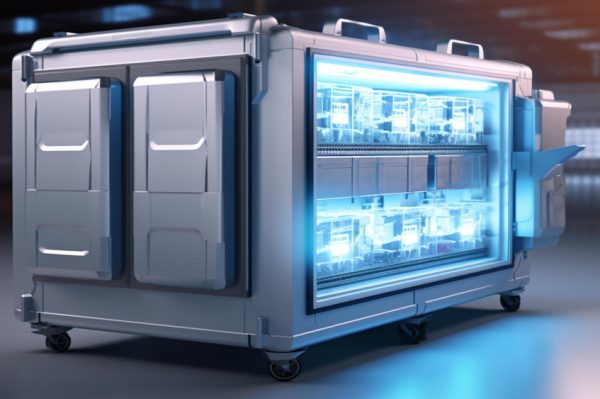







Temperature-controlled transport is changing fast. Modern refrigeration units are no longer just capable of producing cold: they are now able to connected, capable of transmitting data in real time and alerting carriers in the event of a problem.
This technology, called remote refrigeration monitoring or fridge telematics, has become an indispensable tool for food, pharmaceutical and logistics transport professionals.
In this article, we will explain:
- what it's like to remotely monitor a truck fridge,
- how it works,
- parameters monitored in real time,
- automatic alerts,
- and benefits for transport companies.
1. What is automatic remote monitoring of a truck fridge?
Automatic remote monitoring involves equipping refrigeration units (Thermo King, Carrier, Zanotti...) with telematic boxes connected to a software or web platform.
These devices automatically collect and transmit essential information on :
- indoor temperature,
- group status,
- alarms,
- energy consumption,
- defrost cycles,
- the vehicle's GPS position.
The objective is simple: make sure that the fridge is working properly and that the cold chain is always respected, without waiting for a manual check.
2. How does fridge telematics work?
The system is based on three elements:
1. A telematic device installed on the refrigeration unit
It is connected :
- to the electronic board,
- temperature sensors,
- door opening sensors,
- the power supply system (diesel/electric).
2. A communication module
It uses :
- GSM/4G/5G network,
- or a satellite network for isolated areas.
It sends the data in real time or at regular intervals.
3. A supervision platform
Accessible on :
- computer,
- tablet,
- smartphone.
It gives you a live view of the fridge's status, so you can be alerted immediately if there's a problem.
3. Automatically monitored information
Remote monitoring is not limited to temperature. Today, systems track all critical parameters of the refrigeration unit.
✔ 1. Inside body temperature
- Actual temperature
- Curve history
- Setpoint deviations
- Abnormal rapid variation
Indispensable for food or pharmaceutical transport.
✔ 2. Operating status of refrigeration unit
The system indicates whether the group is :
- in cooling mode,
- in anticipation,
- on standby,
- out of order,
- defrosting.
✔ 3. Power supply (diesel / electric)
We always know if the group is :
- powered by the truck's engine,
- in stand-alone diesel mode,
- connected to the mains (stand-by).
Useful for warehouses and urban deliveries.
✔ 4. Autonomous unit fuel level
For units with independent diesel engines, the fuel level is transmitted, preventing dry runs.
✔ 5. Door opening
The sensors record :
- each opening,
- the duration of the opening,
- abnormal openings outside a designated area.
Perfect for securing goods.
✔ 6. GPS and trip tracking
The system displays :
- the exact position of the truck,
- the distance covered,
- stops,
- delivery zones.
✔ 7. Alarms and error codes
Any technical problem is displayed in real time:
- compressor overheating,
- low pressure or high pressure,
- fan failure,
- low battery,
- possible fluid leak,
- sensor failure.
These alerts allow you to intervene before the temperature exceeds critical limits.
4. Automatic alerts: a powerful prevention system
One of the greatest advantages of remote surveillance is the ability to instant alerts.
The user receives real-time :
- a text message,
- an email,
- or an application notification
These alerts can warn of :
- temperature too high,
- unit failure,
- engine stop,
- low battery,
- insufficient fuel level,
- door open too long,
- loss of GPS signal,
- compressor fault.
This avoids :
- loss of merchandise,
- an empty return,
- a customer dispute,
- an unscheduled stop.
5. Benefits of automatic remote monitoring for companies
This technology brings concrete, measurable benefits.
✔ 1. Maximum cold chain safety
Companies can prove :
- that the temperature setpoint has been respected,
- that the product has never suffered a cold break.
This is crucial for the food and pharmaceutical sectors.
✔ 2. Reduced breakdowns and unscheduled maintenance
By monitoring upstream components, we can detect :
- drops in performance,
- weak fans,
- pressure drifts,
- electrical problems.
This makes it possible to intervene before the breakdown.
✔ 3. Fuel savings
The system optimizes :
- group cycles,
- periods of independent walking,
- engine consumption.
✔ 4. Facilitating audits and controls
Temperature histories are automatically recorded.
Very useful for HACCP or ATP audits.
✔ 5. Reduce customer disputes
In the event of a dispute, the carrier can provide temperature curves proving that the product has been kept cold.
✔ 6. Route optimization
Thanks to GPS, the :
- follows its vehicles,
- optimizes journeys,
- monitors stops,
- reduces delays.
6. Essential technology for the future of refrigerated transport
Fridge telematics become a worldwide standard.
It improves safety, reduces losses and simplifies fleet management.
At a time when traceability requirements are increasingly stringent - particularly in the food, pharmaceutical and logistics sectors - automatic remote tracking has become an essential tool.