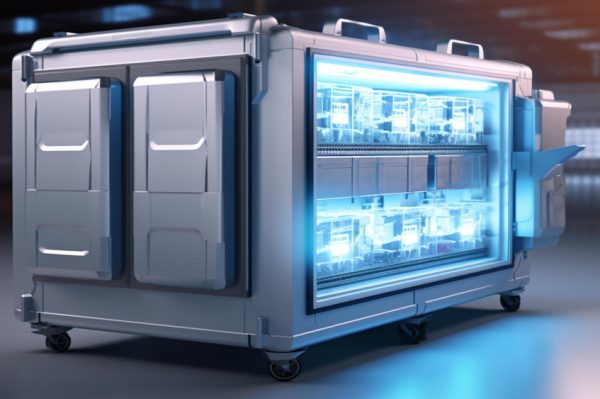







Today, refrigerated transport is indispensable for preserving the quality and safety of a multitude of products. To carry out this mission, professionals use an essential device: the truck fridge, also known as refrigeration unit, refrigeration unit, refrigerated truck or refrigerated truck.
In this comprehensive article, we'll look at:
- what a truck fridge really is,
- how it works,
- what its main components are,
- in which sectors it is used,
- and why it has become an essential part of the modern supply chain.
As you read on, you'll also find links to the spare parts you need for maintain, repair or optimize your refrigeration unit, available on Frigo Parts, a specialist in equipment for Thermo King, Carrier and other brands on the market.
1. What is a truck fridge?
A truck fridge is a refrigeration system built into a commercial vehicle or truck, designed to maintain a precise, constant temperature inside its body.
It can be used to transport goods in temperature ranges such as :
- +15°C to +4°C fresh produce
- 0°C to +2°C meat, fish, sensitive products
- -18°C Frozen food
- down to -25°C for highly sensitive products
To guarantee this thermal stability, carriers often have to replace or maintain components such as the compressor, l’evaporator, the condenser, or the filter driers - easily available on :
👉 https://www.frigo-parts.com/
2. The main components of a truck fridge et their role in maintaining the cold chain
A truck fridge is made up of several essential components that work together to ensure a stable temperature inside the body. Each plays a precise and indispensable role in the refrigeration cycle. Here's a detailed explanation of these components and their importance.
- The compressor - The heart of the refrigeration system
Visit compressor is the centerpiece of a refrigeration unit. Its role is to compress the refrigerant, putting it under high pressure and temperature. This process enables it to circulate throughout the circuit and begin the cooling cycle.
What does it actually do?
- It draws in gaseous refrigerant from the evaporator.
- It compresses it to increase its pressure and temperature.
- It sends the compressed fluid to the condenser for cooling.
Why is it essential?
Without compressor, no cold can be produced. It is the very engine of the system. Compressor failure brings refrigeration to a complete standstill, and therefore poses a major risk of breaking the cold chain.
Common problems :
- Lack of lubrication
- Overheating
- Mechanical wear
- Internal leaks
- Abnormal noise or vibration
This is one of the most critical elements to monitor, and also one of the most expensive to replace.
- The evaporator - The element that actually produces the cold
The evaporator is located inside the refrigeration box. It absorbs the interior heat to turn it into useful cold.
How does it work?
- The refrigerant enters the evaporator at low pressure.
- It evaporates, absorbing heat from indoor air.
- This heat absorption cools the inside of the body.
This is the part of the system that manufactures the cold felt in the truck.
Risks and common problems :
- Excessive icing due to poor air flow or lack of defrosting.
- Refrigerant leaks.
- Air passage blockage dust, leaves, cardboard, ice.
- Internal fans faulty.
Without a clean, functional evaporator, indoor temperatures rise rapidly.
- The condenser - The heat removal element
The condenser is usually installed at the front of the truck, above the cab, or at the rear on some models.
What's its role?
- It receives high-pressure refrigerant from the compressor.
- As the fluid cools, it releases the heat absorbed in the body.
- The fluid returns to liquid to continue the cycle.
It is therefore the element that enables the system to’vent the heat generated by the truck to the outside.
Why is it crucial?
If the condenser can no longer reject heat, the system overheats and loses its efficiency.
Result:
- Cold is no longer enough.
- The compressor works harder and wears out prematurely.
Common problems :
- Condenser dirty (dust, insects, pollen, grease).
- Fans out of order.
- Leaks due to corrosion or vibration.
Regular cleaning is essential to avoid breakdowns.
- The expansion valve - The part that regulates cold
The expansion valve is a regulating part. It controls the quantity of fluid entering the evaporator.
How it works :
- It reduces fluid pressure.
- It precisely meters the quantity of fluid to be fed into the evaporator.
- It balances the high-pressure and low-pressure sides of the circuit.
Why is it essential?
Incorrect dosage results in :
- too much cold → frost, over-consumption, risk of blockage,
- not enough cold → unstable temperature, loss of performance.
Common faults :
- Expansion valve clogged or partially obstructed.
- Wrong setting.
- Malfunction due to humidity.
- Filter driers - System protectors
The filter drier is an often overlooked but absolutely essential component.
It has two main functions:
1. Absorb moisture
Water is a refrigeration system's #1 enemy.
It can cause :
- ice formation,
- regulator blockages,
- internal corrosion,
- refrigerant degradation.
2. Filter out impurities
It retains :
- metal particles,
- oil residues,
- dust,
- micro-debris.
This prevents damage to the compressor or expansion valve.
When to replace it?
The filter drier must be changed every :
- circuit opening,
- compressor change,
- leak repaired,
- in-depth interview.
A saturated filter becomes totally ineffective and can even cause serious breakdowns.
- The electronic board - The brain of the refrigeration unit
The electronic board is the truck's central management system.
What does it control?
- Indoor temperature
- Cold cycles
- Fan operation
- Automatic defrosting
- Alarms and error codes
- Diesel/electric mode (for stand-alone units)
It ensures temperature stability in real time.
Common faults :
- Burnt-out electronic components
- Faulty sensors
- Wrong wiring or contacts
- Programming problems
When the electronic board fails, the refrigeration unit becomes totally uncontrollable: either it stops cooling, or it cools too much.
3. How does a truck fridge work?
The operation is based on a refrigeration cycle which repeats continuously:
- Visit compressor compresses the refrigerant.
- The hot fluid is cooled in the condenser.
- It is relaxed via the pressure reducer.
- It evaporates into the’evaporator, creating a chill in the body.
- The fluid returns to the compressor and the cycle starts again.
This system maintains the right temperature, even in midsummer or during frequent shutdowns.
4. The different types of truck fridge
There are several models to suit different transport needs:
✔ Self-contained diesel refrigeration units
Operate independently of the vehicle engine.
Ideal for long distances and semi-trailers.
✔ Electric refrigeration units (stand-by)
Used at standstill in warehouses, thanks to a 230V or 380V power supply.
✔ Single-temperature
A single cold zone: perfect for specialized transporters.
✔ Multi-temperature
Several independent zones in the same box.
Ideal for city tours:
- one compartment at +4°C
- another at -18°C
- a third at room temperature
5. Applications for a truck fridge
A truck fridge is indispensable in a multitude of professional sectors.
1. The food industry
Transport from :
- meat
- fish
- dairy products
- fruit and vegetables
- ready meals
- frozen food
Transporters must comply with health standards and maintain the cold chain, which requires a reliable, well-maintained system.
2. Pharmaceutical and medical transport
Transport from :
- vaccines
- sensitive medicines
- blood bags
- biological analyses
The slightest difference in temperature can render products unusable.
3. Urban logistics / short-distance deliveries
Refrigerated trucks are essential for delivering :
- supermarkets
- restaurants
- hotels
- caterers
- school canteens
4. Florists and plant wholesalers
Flowers often need to be stored between 5°C and 10°C to stay fresh during transport.
5. Sensitive chemicals
Some products react strongly to temperature variations.
Refrigerated transport avoids risks.
6. Heat-sensitive cosmetics
Some creams, oils and lotions can degrade in the heat.
6. Why maintain your truck fridge regularly?
A poorly maintained refrigeration unit leads to :
❌ excessive fuel consumption
❌ reduced cooling performance
❌ risk of loss of merchandise
❌ costly breakdowns (compressor failure, fluid leaks, etc.).
Conclusion
A truck fridge is an essential technology for the transport of sensitive goods. Thanks to its complex system (compressor, evaporator, condenser, electronic board, etc.), it guarantees temperature control and product safety.
Today, it is indispensable in a wide variety of fields: agri-food, medical, cosmetics, chemicals, catering...
Regular maintenance and quality parts are essential to keep it running smoothly.
Find all spare parts for truck fridges (Thermo King, Carrier, etc.) on : https://www.frigo-parts.com/